CONVERSATIONS with Ed Tracy

Inspire. Educate. Entertain.

CONVERSATIONS|PicksInSix®Reviews featuring short form critical reviews and podcasts with authors and influential leaders in the arts, media and business.

Filtering by Tag: Chuck Smith

PicksInSix Gold Review: Ma Rainey's Black Bottom - Goodman Theatre
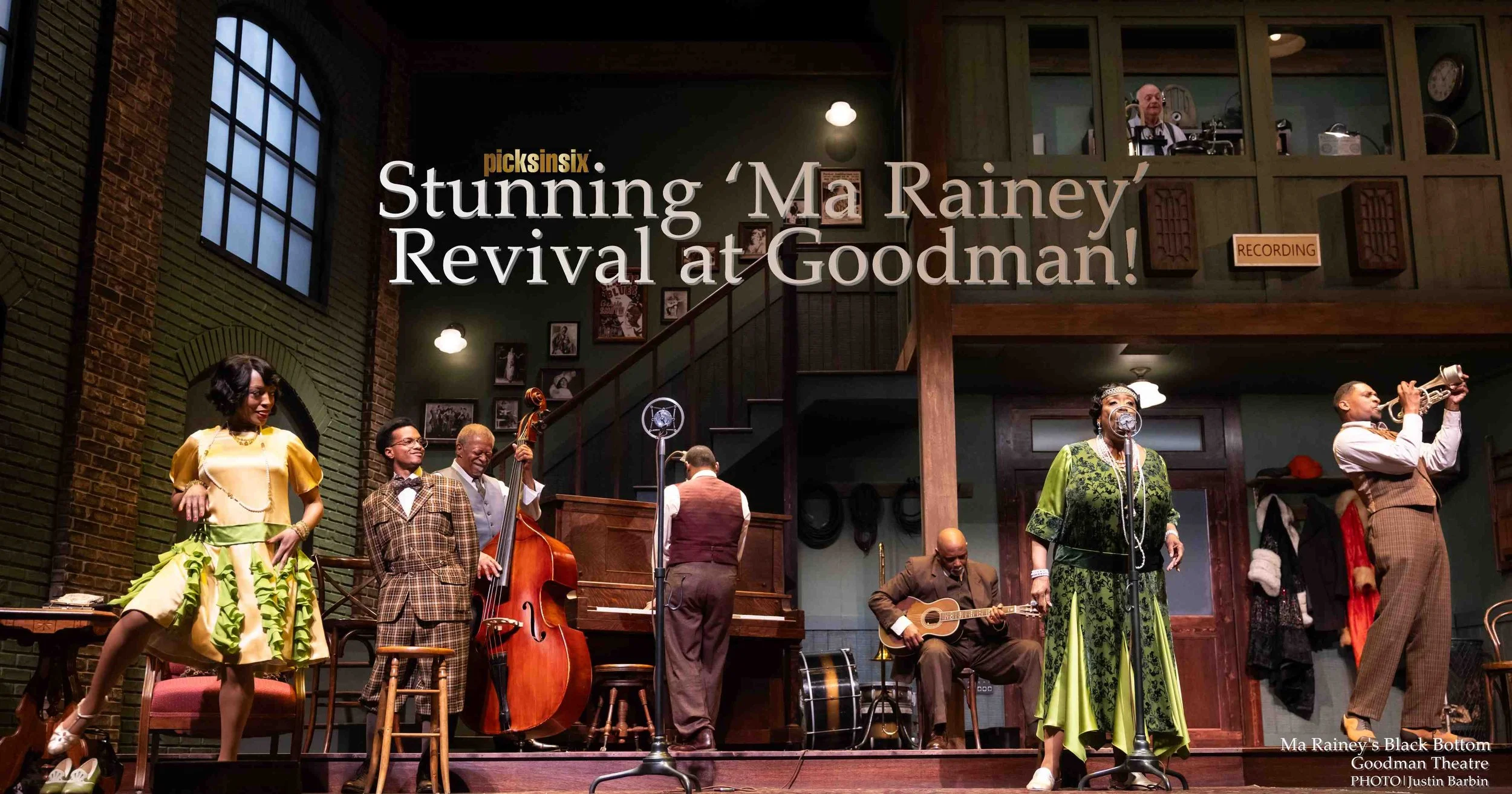


Stunning ‘Ma Rainey’ Revival at Goodman!
PicksInSix® Gold Review |
Ed Tracy

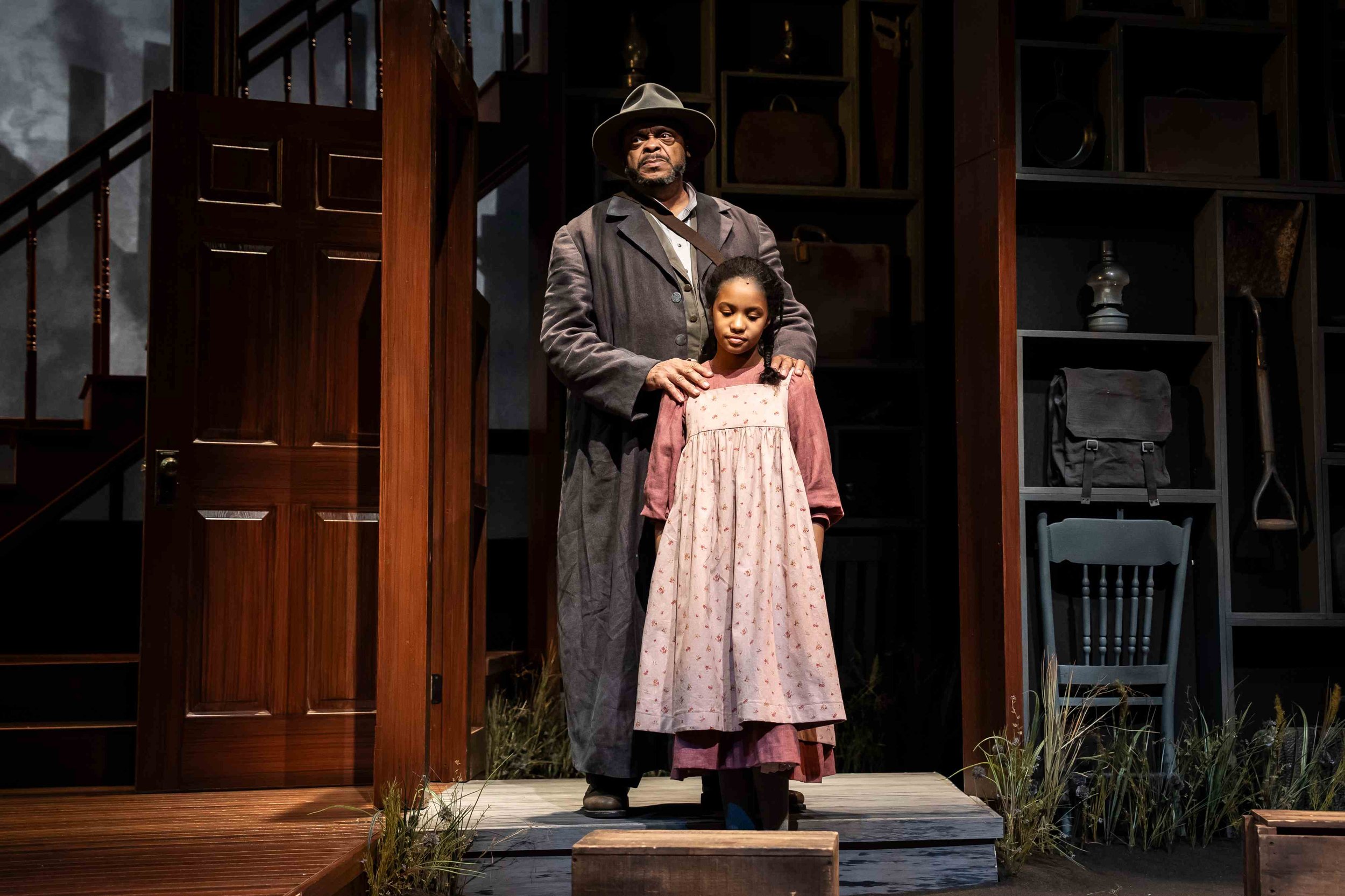
The 1982 drama “Ma Rainey’s Black Bottom”—August Wilson’s study of Black music and culture in Chicago during the tumultuous 1920s—is the only one of ten plays in Wilson’s landmark Century Cycle set outside of Pittsburgh. The epic 1997 Goodman production, directed by Chuck Smith in collaboration with Wilson, looms largely at the top of a list of bold and inspiring productions in the rich 100-year history of the theater.

It’s difficult to discern if Wilson’s brilliant work shines brighter through Chicago’s gritty undertones or if the heart of Chicago theater beats more profoundly by Wilson’s attention. One thing is clear: the powerful force of Wilson’s legacy has helped to both expose and define the harsh realities of racial inequality and social injustice in America, whenever and wherever his plays are performed. And this production, at this time in Chicago with its phenomenal cast, provides a brilliant opportunity to experience the emotional thrust, the preciseness of the lyrical dialogue and the realization of Wilson’s complex characters.

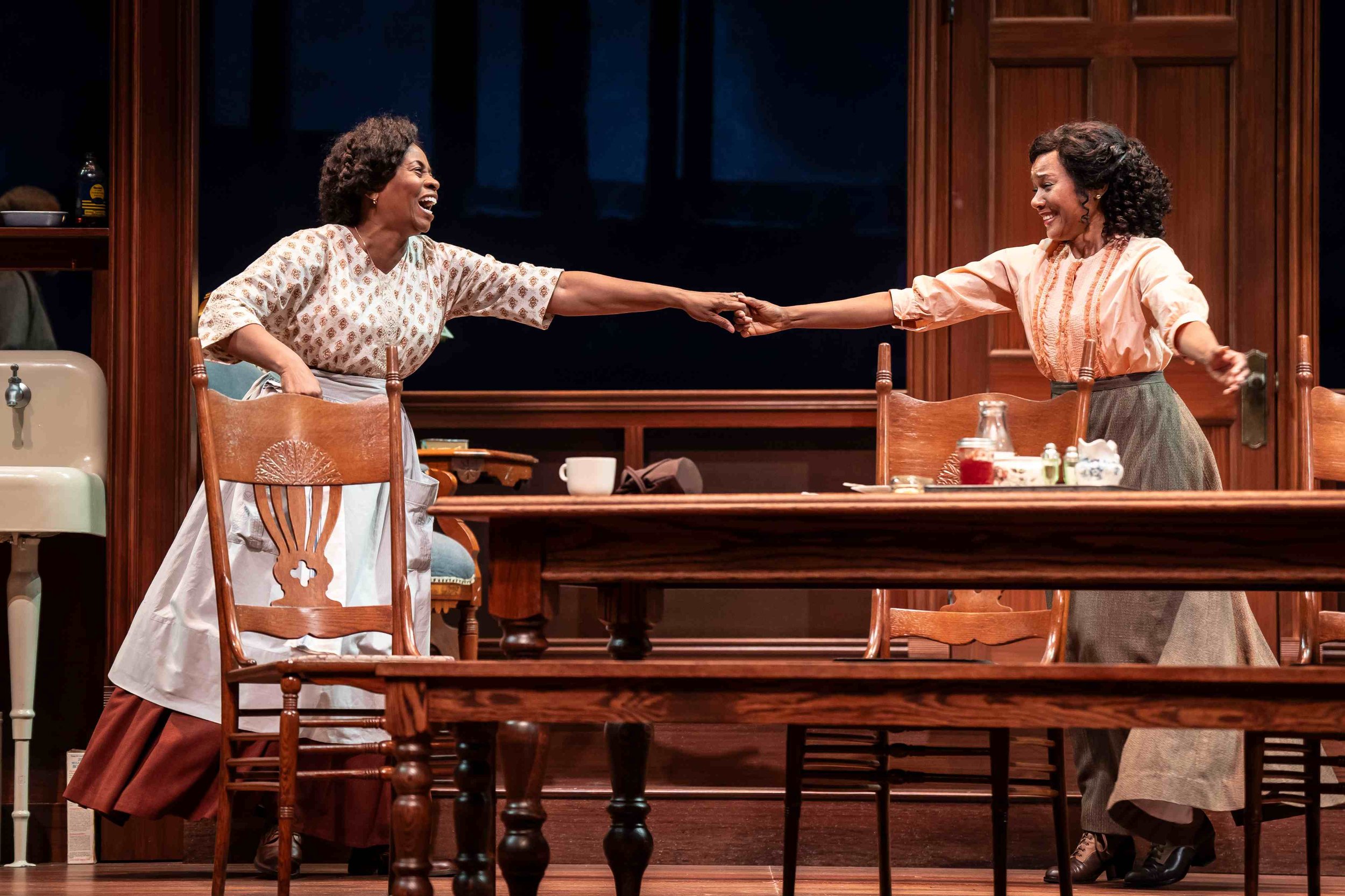
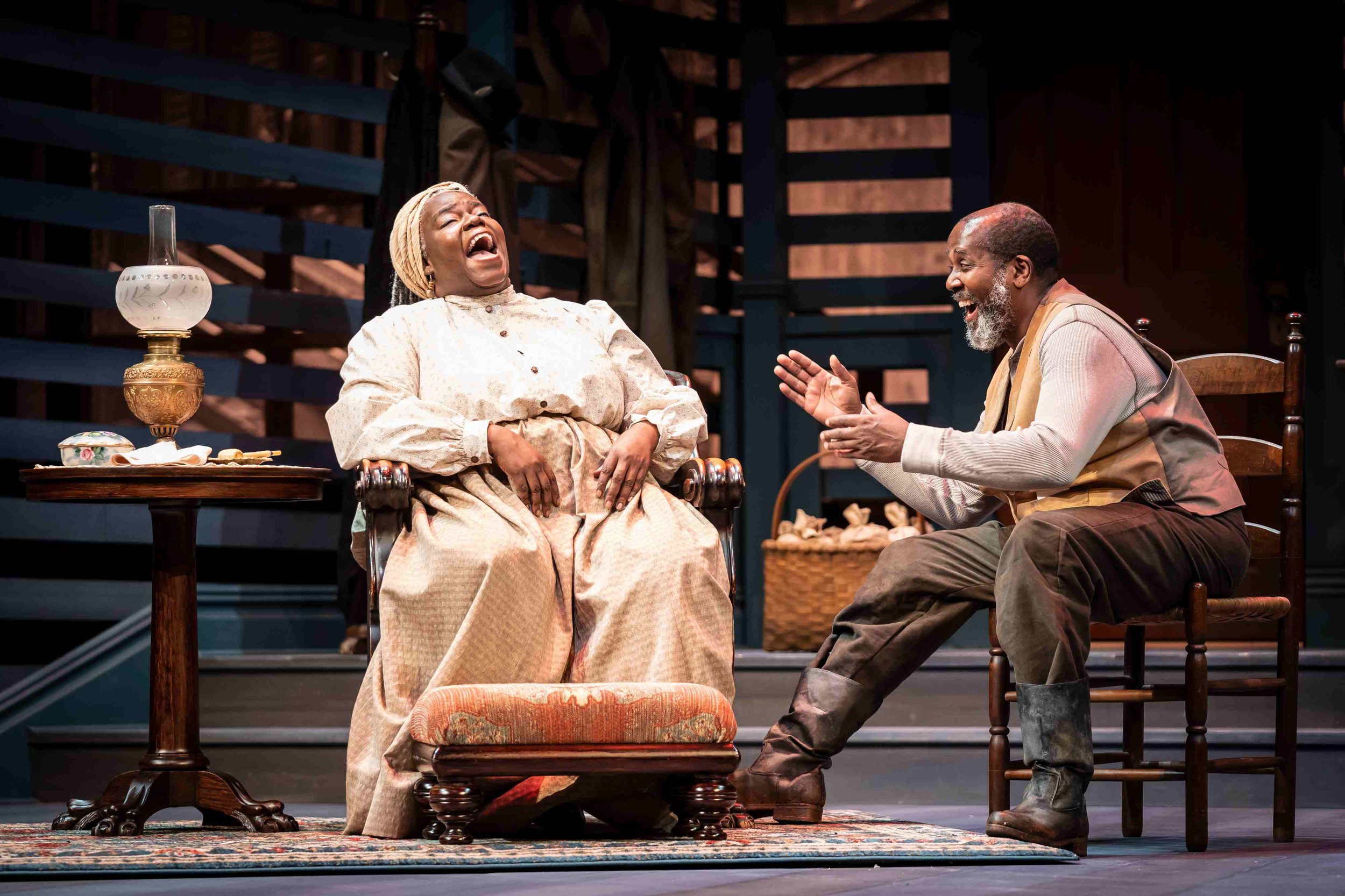
Both director Smith and associate director and music director Harry Lennix, who played Levee in the 1997 production, have returned to forge the stunning revival that opened Monday night in the Albert. It is a story about the true-to-life presence of Ma Rainey (E. Faye Butler) whose unequalled talent and rebellious influence on the music of the era reflects the challenges that run through all of Wilson’s work. It is also a piece that has stood the test of time, as powerful and gripping a drama today as then with a dream team of a cast.


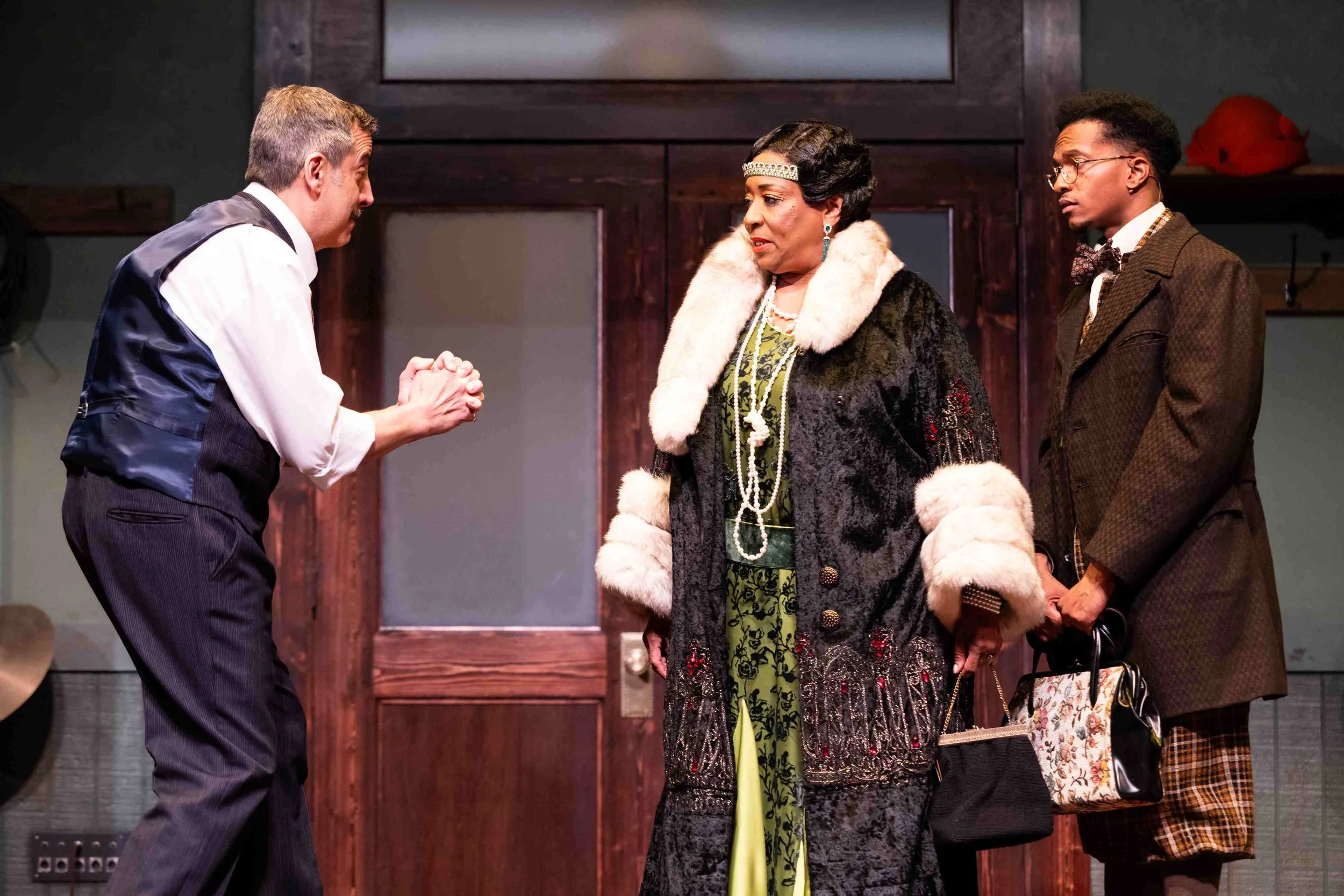
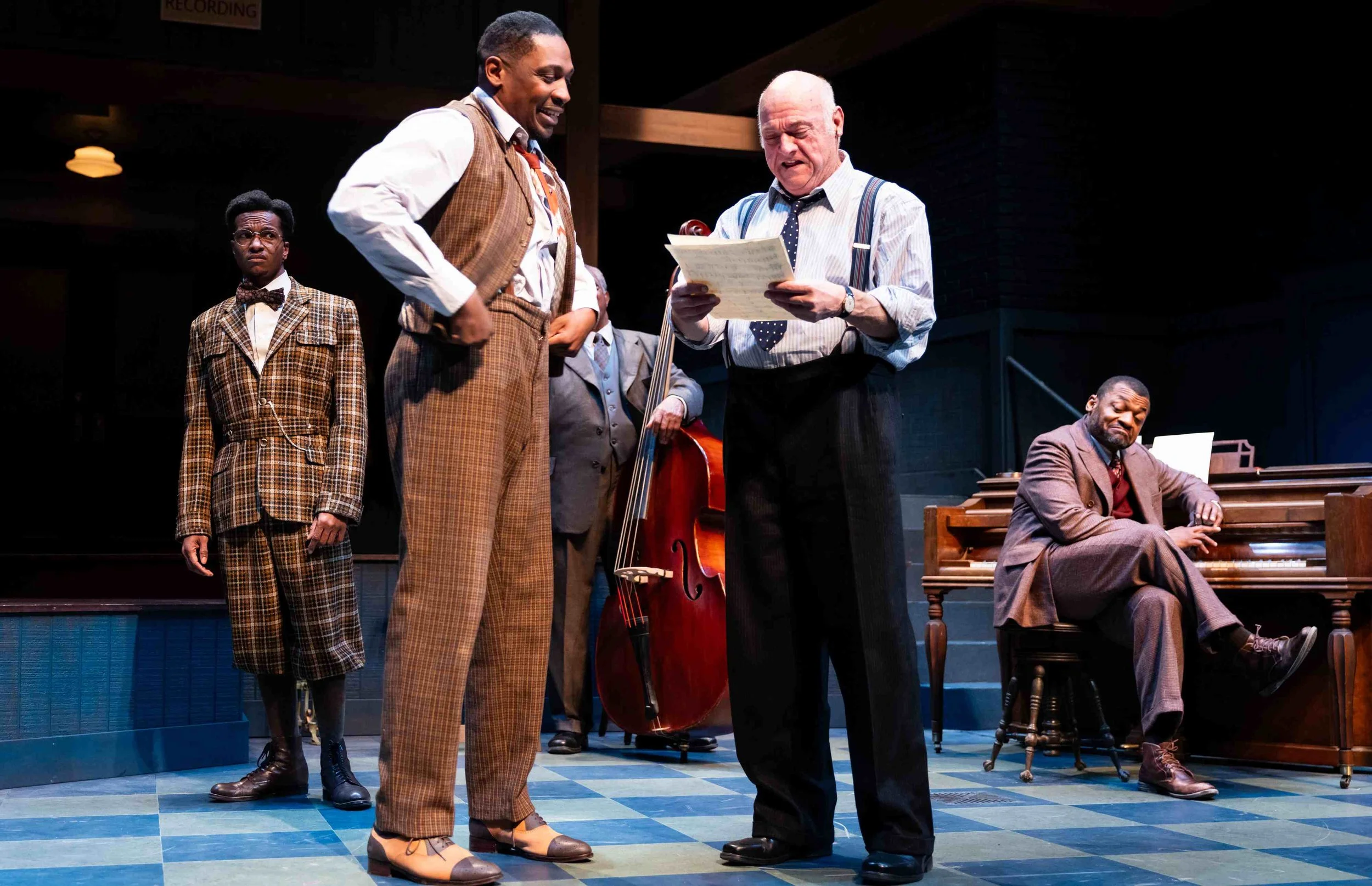
It’s March 1927 and Ma Rainey and her band—Sylvester (Jabrai Khaliq), Levee (Al’Jaleel McGhee), Toledo (Kelvin Roston Jr.) and Slow Drag (Cedric Young)—are gathering at a Southside recording studio run by Sturdyvant (Matt DeCaro) to record a new album. Ma’s manager Cutler (David Alan Anderson) must deal with Sturdy’s impatience when Ma and her entourage—nephew Irvin (Marc Grapey) and the sultry Dussie Mae (Tiffany Renee Johnson)—who are nowhere to be found.

In the meantime, Slyvester, Toledo and Slow Drag get along well in the rehearsal room, each loyal to Ma’s powerful influence and committed to doing the job they have been hired to do. The dynamic changes significantly when Levee arrives, decked out in his new shoes and emboldened by Sturdy’s commitment to use his arrangements with a promise to record other songs with a band of his own. The others don’t buy it, even when Cutler tells them that the decision to use Levee’s arrangements has been made.

That conversation sets the stage for Ma’s blistering arrival and the realization that there is only one opinion that matters in the room. Ma Rainey arrives in a whirlwind of commotion, driven by the presence of policeman (Scott Aiello) who wants to arrest Ma for a traffic accident on the way to the studio. To nobody’s surprise, the unfolding plans for the session do not jive at all with Ma either. The band is sent back down for rehearsal with Irvin, who will be doing things Ma’s way, despite Irvin’s pronounced speech impediment.
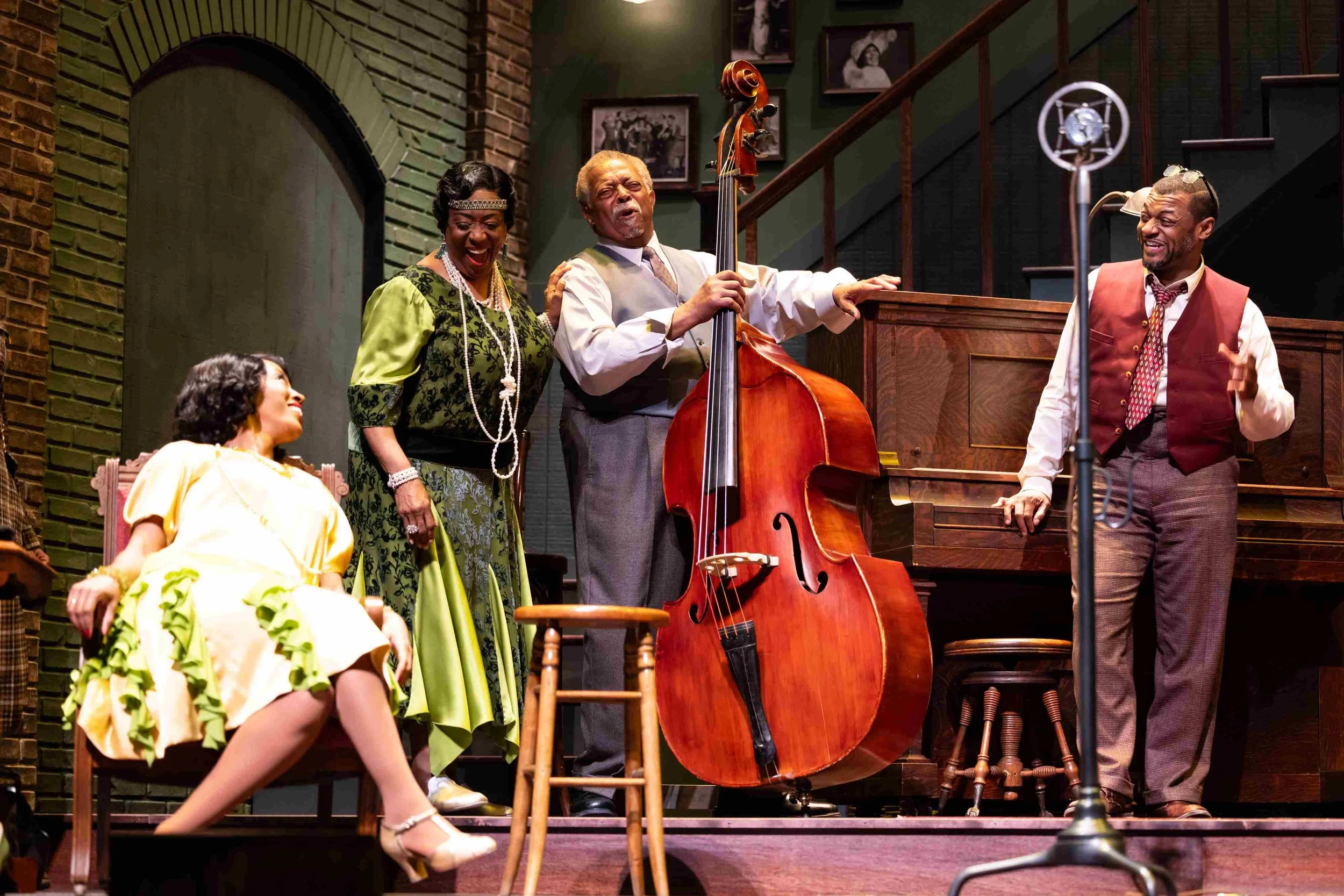
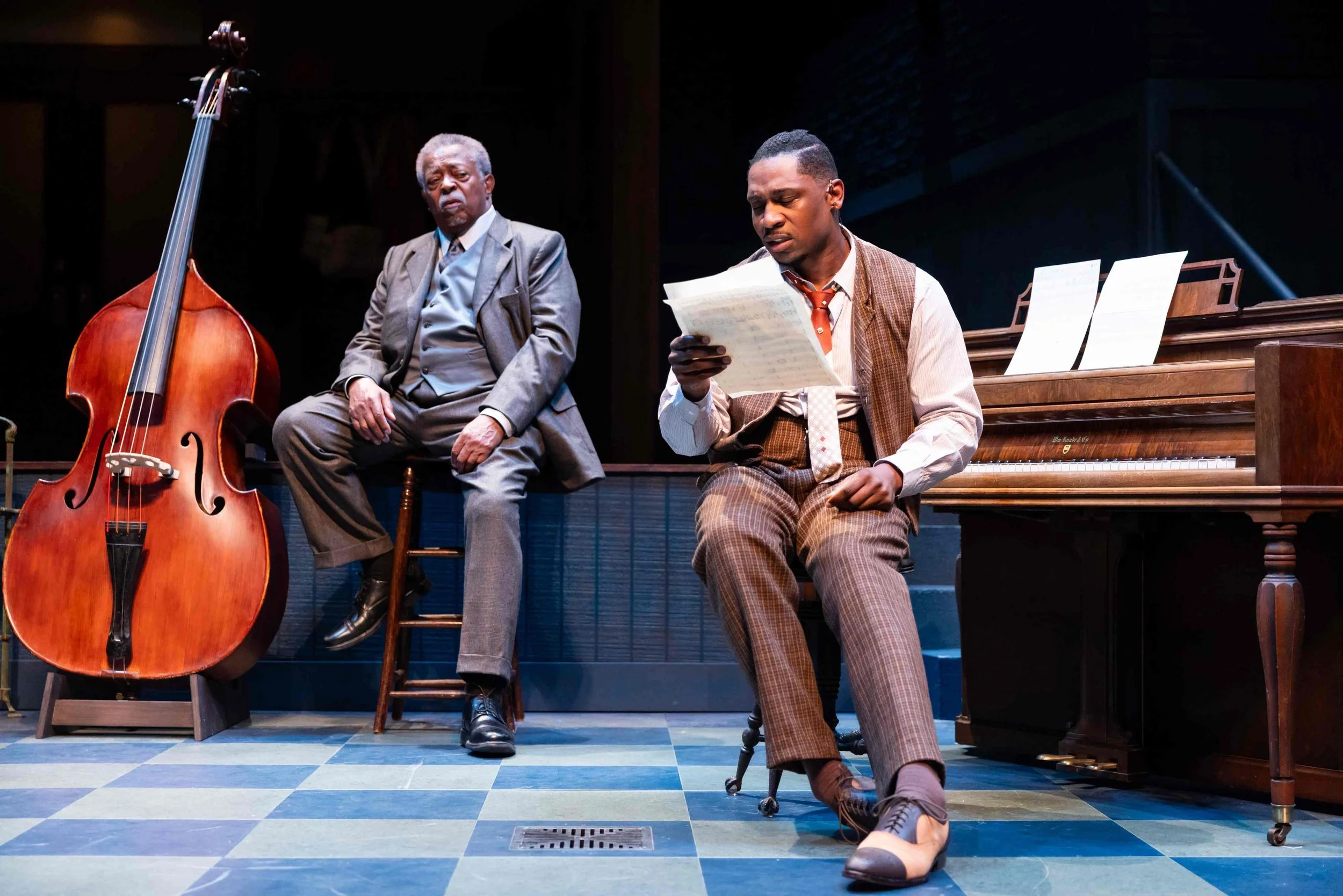
The conflict comes to a head when Ma and Levee face off on the direction of the recording of her signature piece “Ma Rainey’s Black Bottom.” Levee represents a new and innovative talent in jazz music but blindly resists the notion that white recording producers are only in it for themselves. Ma Rainey and her contemporaries in the band recognize that they will receive only token payments and little respect for their work, while Levee’s hopes continue to be dashed at virtually every turn, fueled by deep-seated images of his youth that eventually prove to be inescapable.

The true power of Wilson’s work lies in Levee’s struggles. McGhee’s commanding performance fires on every cylinder in the challenging role, as the emotionally unhinged Levee shifts on a slow burn from impassioned musician to deranged psychopath, the helpless victim of his own violent and embattled childhood.

The production runs expertly through Butler’s super-charged performance as Rainey, alternating between her larger-than-life presence, striking fear in virtually everyone within earshot, to her mesmerizing vocal’s and the touchingly quiet reflective moments where Butler peels back the public image and shares Rainey’s innermost feelings with Sylvester. Director Smith’s pacing expertly elevates the lighthearted exchanges and so solidly stages this drama that, at the most gripping moments, you can hear a pin drop.

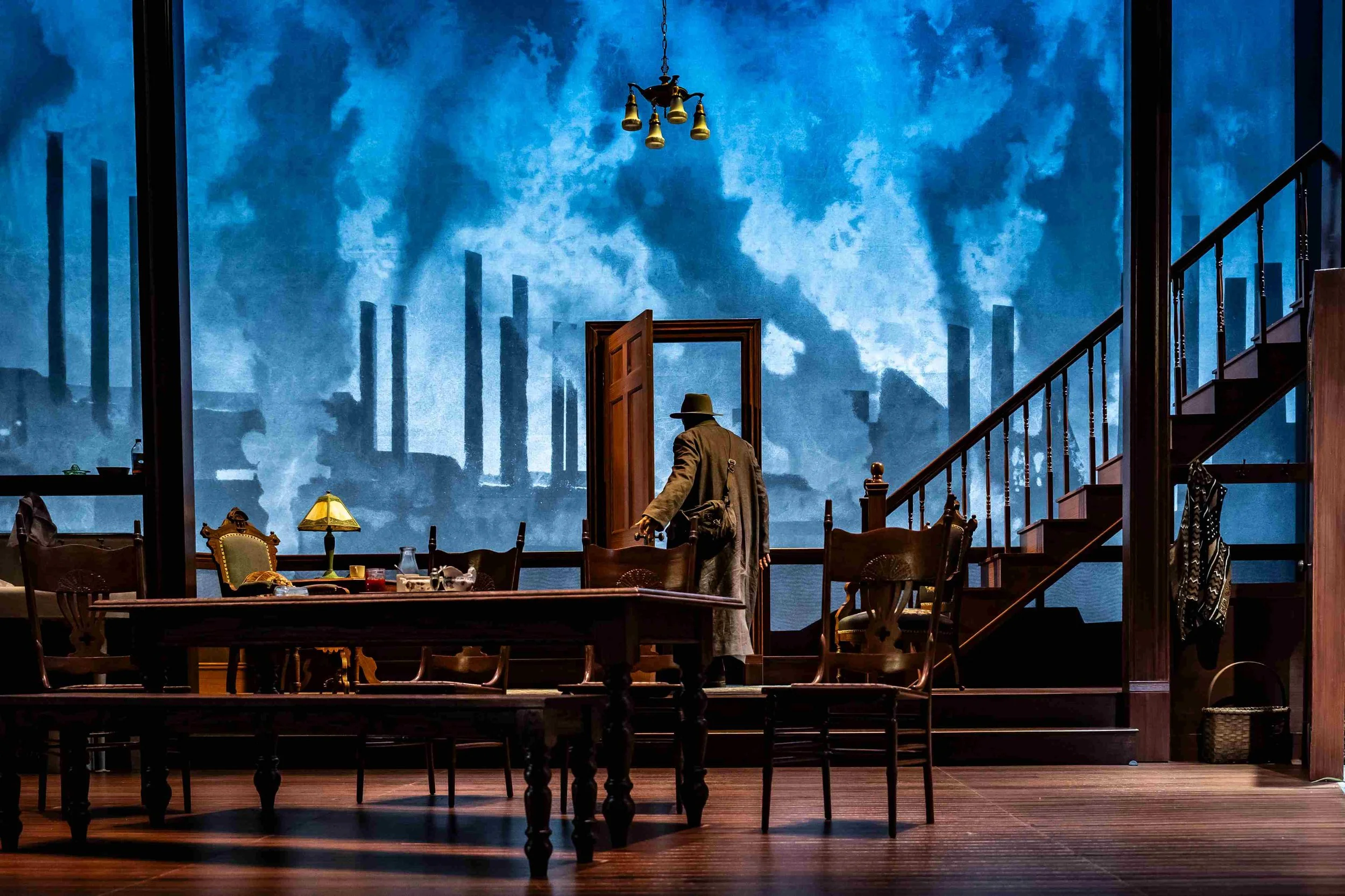
It all unfolds on Linda Buchanan’s gritty set design, an urban, tri-level structure capped by a control room above the main recording studio that is connected by stairs to a lower level rehearsal room. Jared Gooding’s stylized lighting design defines the areas and extends beyond the staged interior providing a reminder of the Chicago streets just outside the door. Evelyn M. Danner’s costumes expertly evoke the period, especially Ma Rainey’s resplendent ensemble. The music direction under Lennix features orchestrations by Dwight Andrews and sound design by Rob Milburn and Michael Bodeen, all placing Goodman Theatre’s “Ma Rainey’s Black Bottom” at the top of the list for shows to see right now in Chicago.

PHOTO|Justin Barbin

Goodman Theatre
presents
Ma Rainey’s Black Bottom
Albert Theatre
170 N Dearborn

Extended through May 3, 2026

WEBSITE

STUDY GUIDE

For more reviews, visit: Theatre In Chicago

ARCHIVE

PicksInSix® is a registered trademark of Roxbury Road Creative, LLC
PicksInSix Review: Golden Leaf Ragtime Blues - American Blues Theater


Generations Collide in Nostalgic ‘Ragtime Blues’
PicksInSix® Review | Guest Contributor | Ronald Keaton

The fine playwright Charles Smith has written a thoughtful play, “Golden Leaf Ragtime Blues,” now playing through June 29 at American Blues Theater's intimate space on Lincoln Avenue. He has offered up lots of food for considerable thought in what is a deceptively simple premise in this Chicago premiere expertly directed by Chuck Smith. Two characters—one, an elderly vaudevillian who does not want to give up the chase for the next laugh; and the other, a young Black teenager with a great deal of history to deal with, as well as personal anger—are thrown together in a shabby apartment to deal with each of their issues. And there are many.

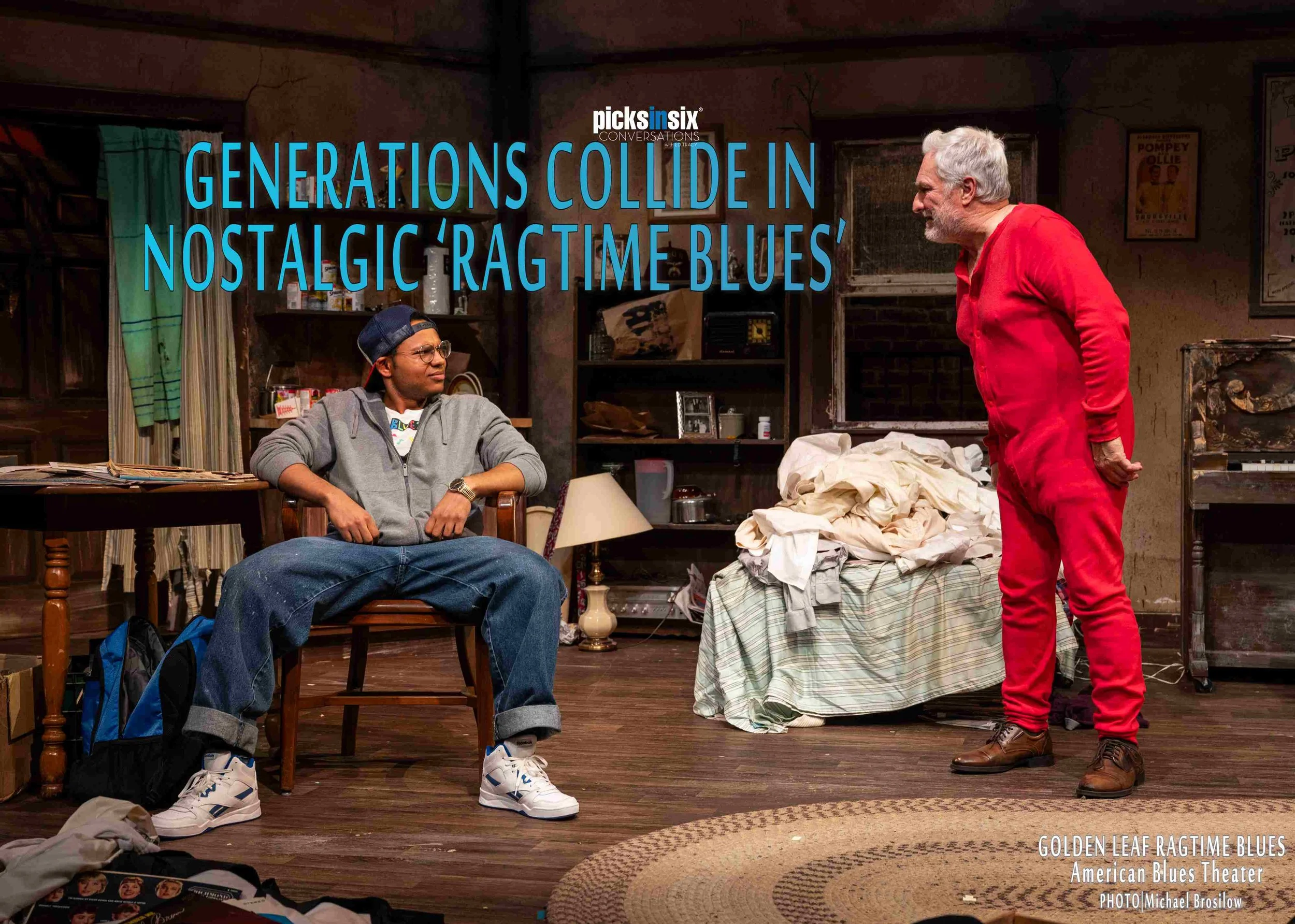
It all takes place sometime in the 1990s. The fictional comedy team of Pompey and Ollie, who played a minor vaudeville circuit as well as any, are rehearsing an old routine. Pompey (such an elegant performance by ABT Ensemble Member Dennis Cockrum) has forgotten a punchline to a joke that he and Ollie (the wonderfully understated James Sherman) have done thousands of times. This is apparently a pattern of forgetfulness by Pompey, so much so that Ollie decides to break up the act. It all rattles Pompey greatly and he holds anger toward an old friend that is not necessarily justified. What it comes down to is the death of Pompey's style of humor.

Segue to Pompey’s apartment, a rundown and not-well-kept living quarters full of old cans and newspapers and laundry that needs to be done. Three weeks ago, Ollie died unexpectedly, and Pompey is so distraught that he pulls out a gun and threatens to shoot himself. He is saved by a knock on the door from his daughter Marsha (Dawn Bach in a strong offering), who has come by on a rare visit. The predictable argument between the generations is interrupted by another knock on the door. A young Black kid, whose nickname is Jet, has come to tell Marsha that her car is about to be ticketed. Soon it comes out that Marsha and Jet (Justin Banks is pretty riveting throughout) have actually talked about adoption, which upsets Pompey to no end.

Marsha finds a way to finally get out the door to take care of the car by going to the grocery store to get her father some food—all he has are endless cans of SpaghettiOs. So now the meat of the play begins. Pompey and Jet play a unique game of cat-and-mouse in letting little bits of personal story out, while each says that he really doesn't care. Jet's history is quite checkered and difficult. Fourteen different foster families. Endless stays in group homes.  His mother died of cancer; his father is in jail for an extended stay because of possession of two joints. Remember this is the early 90s, when laws about marijuana were much stricter, and minorities were overly charged and convicted in such matters.

The strengths in the Smith script are dominant here. The constant tensions that ping-pong back and forth between Pompey and Jet are admirably handled. This could sink into a battle of stereotypes, and it avoids that trap through fun ideas from the playwright's rich, creative arsenal. Pompey and Jet actually toy with the idea that they might partner up and create their own act. But Pompey's jokes are hopelessly outdated, so Jet suggests adapting some blue material from the recordings of Redd Foxx, which are hilarious on their own. We then get the privilege of seeing Pompey react to Jet's sharing in comedic horror. Then there are the highly personal moments. Jet talks painfully of seeing his mother being driven away in an ambulance, while the authorities take him into juvenile custody and, eventually, his first group home.  Pompey fights a strong feeling of irrelevance by constantly delving into his bag of show business jokes and details. It's a unique exchange that seems headed toward a kind of happy moment.  Until...

And the last ten minutes or so, I will leave for future audiences to discover. Mr. Cockrum is simply grand in his element here as the sad clown who can't find his way to happiness in life. Mr. Sherman appears in moving, ghostly form a couple of times after Ollie's death in Pompey's thoughts to help him find his way. Ms. Bach injects some informed depth into her Marsha, a woman of her time in holding down a job while feeling the attraction, however drawn she is, to a kind of motherhood. Mr. Banks is the real dramatic coin in the ensemble, making sure that Jet's generation is regarded by Pompey as more than a stereotype. In the hands of Mr. Banks, Jet is indeed a real flesh-and-blood young man playing the cards he's been dealt as well as he knows how. And it's all directed with the usual expert eloquence by the wonderful director Chuck Smith. The experience here is noble, nostalgic, achingly personal and deserves all praise.

GUEST CONTRIBUTOR | RONALD KEATON received an Equity Jeff Award for the performance of his one-man show CHURCHILL. www.solochicagotheatre.com  Coming soon, his new solo play “Teddy’s Last Ride.”

PHOTO|Michael Brosilow

American Blues Theater
presents
Chicago Premiere
Golden Leaf Ragtime Blues
5627 N Lincoln
through June 29, 2025


WEBSITE

TICKETS

PROGRAM

BACKSTAGE GUIDE

For more reviews, visit: Theatre In Chicago

ARCHIVE

PicksInSix® is a registered trademark of Roxbury Road Creative, LLC

PicksInSix Review: Joe Turner's Come and Gone - Goodman Theatre


Riveting Performances Drive Goodman’s “Joe Turner”
PicksInSix® Review | Guest Contributor | Ronald Keaton

“A man forget his song, he forget who he is”… It was a line shared by Bynum Walker, a ‘conjure man’ whose awareness of life and people is reflected in Walker’s role as the compass, the conscience of “Joe Turner’s Come and Gone,” the staggering August Wilson play now at the Goodman Theatre through May 19.  There are several themes that flow throughout the play, all expertly articulated by Mr. Wilson—the song inside us all, identity, search, discovery, prejudice, the effect of money, the comparison of status, the supernatural, on and on.  It quietly inspires us to follow on one hand, then forcefully repels us with its stark reality on slavery and its influence on culture and society.

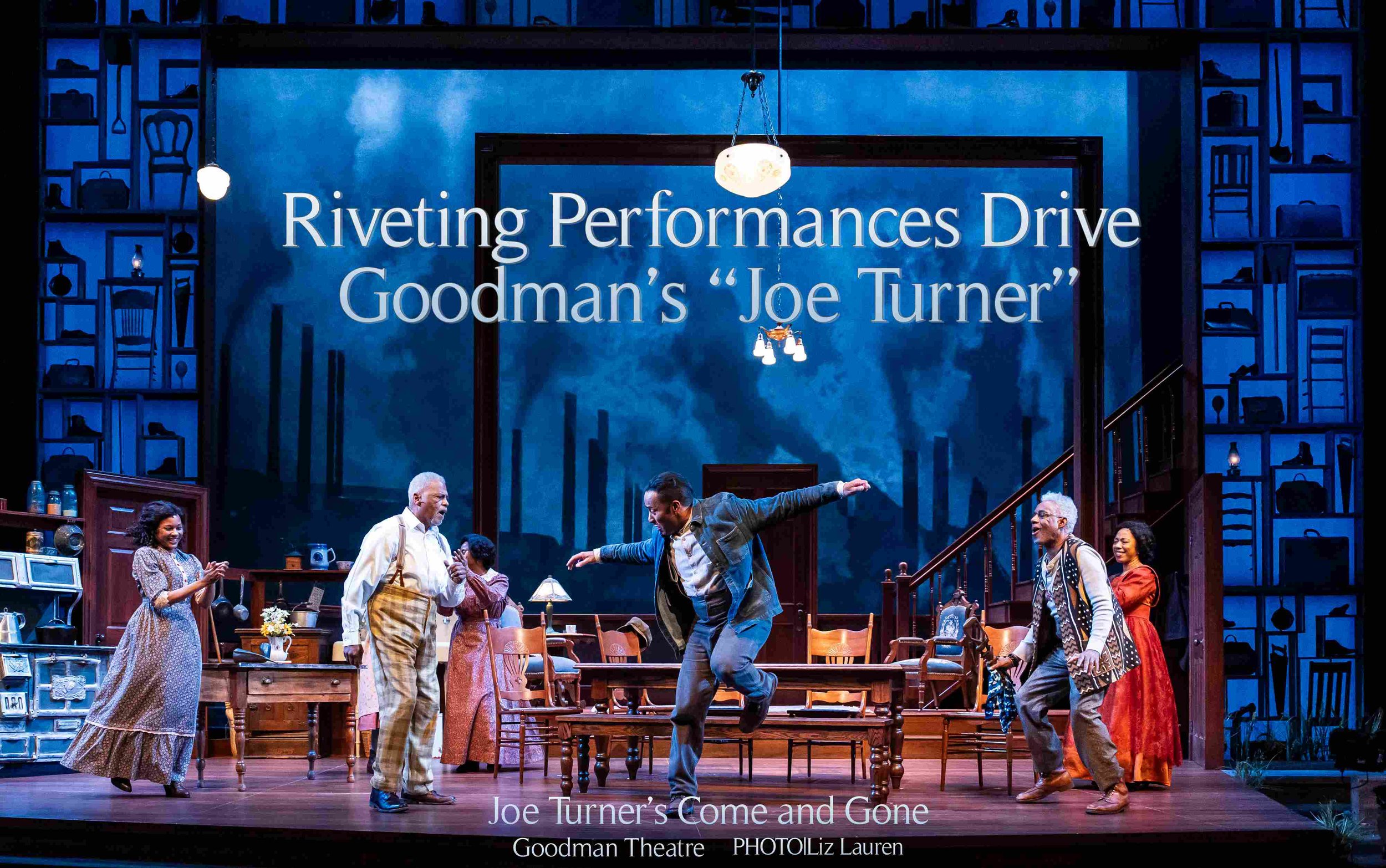
The story is so thick and full of imagery that it’s a real challenge to distill its essence in this forum.  It ostensibly takes place in and around the steel mills of 1911 Pittsburgh, focusing on the boarding house of Seth Holly (an easy, yet riveting portrayal by Dexter Zollicoffer), who charges guests a weekly rate “up front” and works at turning scrap metal into dustpans; and his wife Bertha (an elegant and comforting TayLar), whose natural ease belies her character’s real moral center in the house. And there’s a cast of wide-ranging tenants and visitors, whose performers all deserve kudos.

There’s the aforementioned Bynum Walker (Tim Edward Rhoze is eloquent, rock-steady and takes Walker’s purpose into firm hands); Rutherford Selig (a stoic, wonderfully deadpan Gary Houston), a peddler and ‘peoplefinder’ who visits the house on Saturdays; Herald Loomis (a dynamic presence from A.C. Smith), whose life was forever altered by ‘Joe Turner’, being kept in slavery for seven years, and whose search for his wife is both heroic and tragic; Mattie Campbell (the wonderful Nambi E. Kelley), a woman waiting for her own man to come home, but who wants to find direction through the eyes of others; and Jeremy Furlow (Anthony Fleming III in a real star turn), playing guitar, romantically preying on women and fighting his bosses all the way to unemployment.

Then there’s Molly Cunningham (Krystel V. McNeil, in a strong rendering of a character with conflicting impulses), a single woman on her own road, whose huge strain of independence tempts all the men in the house; Martha Loomis (Shariba Rivers skillfully inhabits her with both a sense of obligation and a feeling of dread), Herald’s wife, who is finally found after all the years of separation; Zonia Loomis (a simply heartbreaking presence by Kylah Renee Jones), who has accompanied her father on this endless quest at the tender age of 11; and Harper Anthony (the charming Reuben Mercer), whose scenes with Zonia result in a first kiss and a realization of growing up.

The grand Goodman spirit Chuck Smith, an avid and long-supportive interpreter of Mr. Wilson’s cycle, directs this play like a symphony conductor, with all the crescendos and quiet moments we can witness, as well as displaying Mr. Smith’s own deep affection for the playwright’s words and thoughts.  The not-so-abstract and stylish set design by Linda Buchanan shows an authority in understanding what’s needed to help tell this complex story.  And here’s something I’d like to mention.  It takes a real professional to keep this moving so smoothly and to affect how an audience perceives it all; the production stage manager Mars Wolfe surely had Mr. Smith’s vision in hand like it was personal.  Exquisite work.

Finally.  We began our reaction here with a referral to song, that we create our lives (or should) with a message of some kind.  Mr. Wilson recognizes that our message is indeed a song inside us, waiting to come out and be recognized in a world that doesn’t always know to do that.  “Joe Turner’s Come and Gone” is a truly extraordinary piece of theatre, of storytelling, of the song that resonates for all of us within the human spirit. 

GUEST CONTRIBUTOR | RONALD KEATON received an Equity Jeff Award for the performance of his one-man show CHURCHILL. www.solochicagotheatre.com  Coming soon, his new solo play “Echo Holler.” www.echoholler.com

PHOTO|Liz Lauren

GOODMAN THEATRE
presents
August Wilson’s
Joe Turner’s Come and Gone

NOW EXTENDED
through May 19


TICKETS

WEBSITE

For more reviews, visit: Theatre In Chicago

ARCHIVE

PicksInSix® is a registered trademark of Roxbury Road Creative, LLC

ALL RIGHTS RESERVED

Copyright 2014-2026

Roxbury Road Creative, LLC

Powered by Squarespace